
Spring in the gorges
Franchard in May: planning a spring day
Franchard works best in May with a flexible plan: visit the Maison when it is welcoming visitors, choose a walk for the conditions and keep an indoor alternative for a changing sky.
Why visit Franchard in spring?
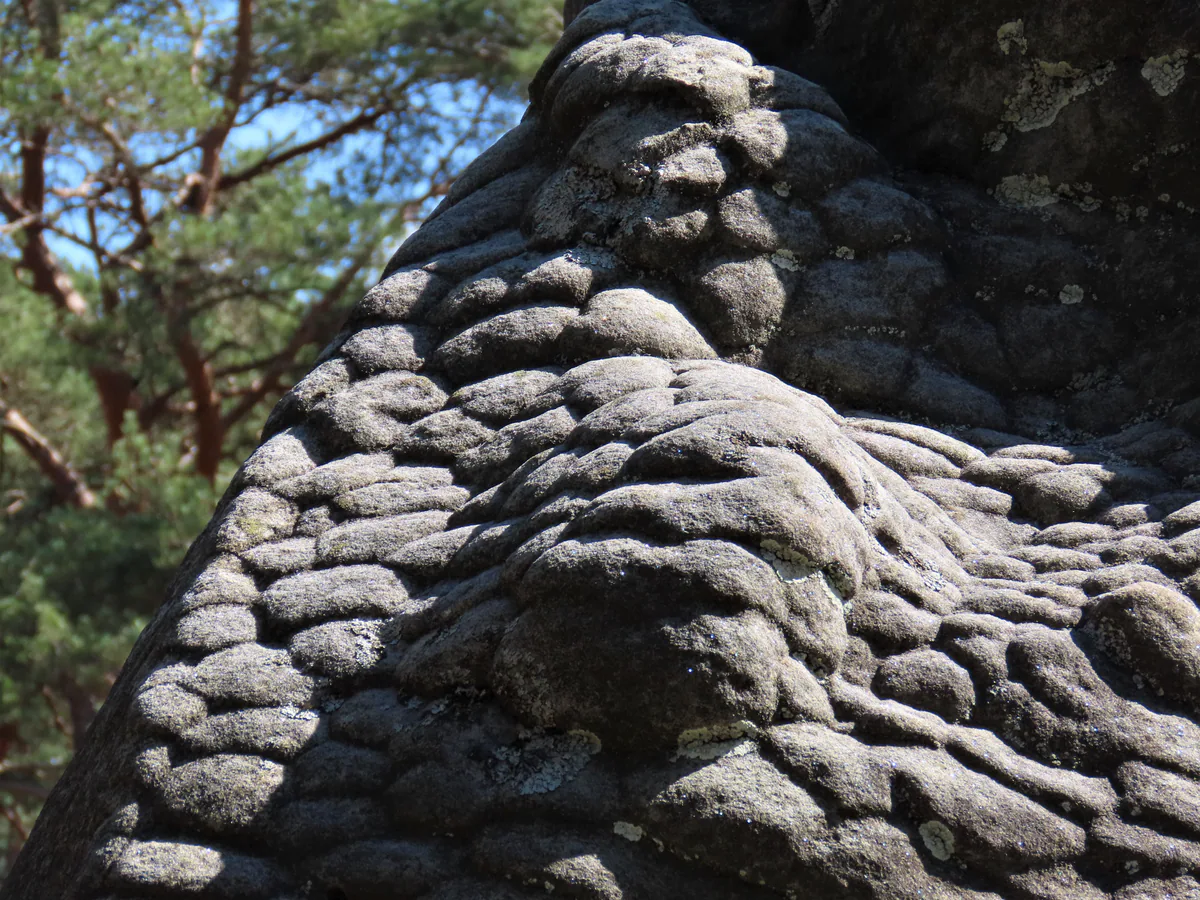
Franchard gives you an immediate sense of what makes Fontainebleau forest distinctive: sand underfoot, sandstone boulders, pine, oak and the narrow passages of the gorges. Leaves fill out during May and the days grow longer, although the ground can still be damp after a shower. Come to look and walk, rather than expecting a checklist of flowers or animals to appear on demand.
The Maison de la Biosphère et de la Forêt stands near the main starting area. It is a useful place to understand the wider landscape and, depending on the programme, may host an exhibition, workshop, talk or guided nature outing. Check the official Visiter et s’immerger page before travelling. It carries announced activities and current contact details. Opening, registration and meeting points should all be confirmed for the day you intend to visit.
May often brings busy holiday weekends. An early start makes parking easier and gives you a quieter walk. A weekday visit, when possible, usually offers more space to linger at the Maison and on the paths.
Choose one of these three days
| What brings you here | A sensible plan | What to check |
|---|---|---|
| A first look at Franchard | Maison when open, followed by a short gorge loop | Keep the roadbook open at junctions |
| A gentle family outing | An age-suitable activity, followed by the Franchard Arboretum | Check path condition and the group’s energy |
| A proper walk | The published Gorges de Franchard trail, with the Maison before or after | Allow for sand, rocks and unhurried observation |
| Uncertain weather | A brief spell outdoors followed by an indoor visit in Fontainebleau | Decide on the fallback before leaving town |
The simplest day joins the Maison with a short walk. Pick up whatever information is available, then set out on one named route. If the Maison is not open, the trip can still work perfectly well. The landscape is the main destination, provided that access is permitted.
For families or groups who prefer a more guided surface, look at the official Franchard Arboretum trail. The enclosed site introduces a varied tree collection and has orientation features. An accessibility label does not replace a check of current surface conditions, parking and each visitor’s individual needs.
If everyone is confident on sand and rocky ground, the official Gorges de Franchard trail page provides a roadbook and track. Our walks around Franchard guide explains the starting point, useful landmarks and choices without turning the walk into a race.
Arrive at the right place
Enter Parking des Gorges de Franchard in your navigation app. The Maison is then reached on foot from the car park. Route forestière de l’Ermitage is not a vehicle route to the front door, even if a journey planner tries to send you along it. Follow the Maison’s published directions rather than a supposed phone shortcut.
Download the ONF map of current forest access before leaving too. A closure, barrier or instruction on the ground takes priority over your saved track. If the car park is full, do not invent a space on the verge or block a forest road or emergency entrance. Choose another part of the forest instead of damaging the edge.
Franchard is not the simplest destination without a car. From a railway station, the final leg needs proper planning and may involve a bus, bicycle, booked taxi or a long walk. Check both directions with Fontainebleau without a car before reserving an activity with a fixed start time.
What to notice in May
Much of the pleasure lies in small changes. Compare the green of a new leaf with evergreen foliage. Listen before speaking in a clearing. Notice how roots hold the sand, how water marks a hollow and how lichens occupy one face of a rock. Smells and colours become stronger after rain, although sandstone and roots also become more slippery.
Do not pick plants for later identification. A clear photograph of the leaf, stem and immediate setting will usually give you enough to continue your research. Never enter a fragile area to approach a nest, flower or animal. Binoculars allow a longer and kinder observation than chasing wildlife with a phone.
Give children a simple mission: find three textures without pulling anything off, sketch the outline of a boulder, count the sounds heard in one quiet minute or compare the shade beneath a pine and a broad-leaved tree. A short investigation holds attention better than an improvised lecture.
Let the forecast decide the route
Rain in the forecast does not always cancel a walk. A brief shower may simply call for a short loop on less technical ground. A thunderstorm warning, strong wind, exceptional heat or an access restriction, however, should lead to a complete change of plan.
Do not climb on sandstone after rain. Even on an ordinary walk, slow down through rocky passages. A light raincoat cannot compensate for shoes that slip or move on the foot. Carry a dry layer when children are with you, since waiting for an activity in wet clothes quickly spoils the day.
Spring also calls for drinking water, sun protection and a tick check afterwards. Stay on paths, wear covering clothes around higher vegetation and inspect skin and clothing after the walk. For personal health advice or after a bite, use an official medical source rather than trying to identify the risk in the car park.
Find an activity for your day
Two calendars cover most visitor needs. The Maison announces its activities on Visiter et s’immerger. The Fontainebleau Tourisme events calendar broadens the search to villages, museums, visits and activities across the Pays de Fontainebleau.
For each listing, check the intended audience, total duration, exact location, any charge, whether booking is required and what happens in bad weather. “Franchard” can describe a broad area, so use the organiser’s page or confirmation email for the true meeting point. Contact the organiser directly if anything is unclear.
Avoid filling every hour with reservations. One activity, one walk and a pause are enough. That space lets you stay with an interesting exhibition or shorten the route when the ground tires the group.
Plan water, a break and toilets
Carry the water you need before entering the massif. The Maison describes a rest and information space with drinks, but do not depend on it without confirming that it is open. Forest ponds and springs are not drinking-water points.
The tourist office says there are no public toilets at the Gorges de Franchard site. Arrange that stop in town before arrival, especially with children. Keep the picnic simple, avoid fragile food sitting in warmth for hours and carry every piece of waste away, including fruit peel. Fires, barbecues and camping stoves should stay at home.
Make the fallback a worthwhile day
If the forest is closed or the weather deteriorates, do not wait in the car park for an uncertain break in the clouds. Return to Fontainebleau for the château, using its official website for current visitor information, or choose a museum and café in a nearby town. Barbizon and Moret-sur-Loing also offer town walks that can be shortened easily.
The best spring plan has two versions: a morning outdoors followed by a visit, or a visit first with a brief forest walk if conditions improve. Franchard rewards another visit. There is never a need to force a long circuit simply to justify the journey.
The evening before, then the same morning
The evening before, choose the route, download its roadbook, save navigation offline and check any registration. In the morning, look at the forecast, ONF map, Maison calendar and your journey. Tell someone where you are going if you are walking alone.
Once there, let the plan breathe. An hour observing the gorges, a few questions at the Maison and a quiet snack can make a richer day than rushing through kilometres. That is exactly what Franchard offers in spring: plenty to see, provided you slow down.