
The journey begins on the platform
Fontainebleau without a car: trains, buses and walking
The train really does bring the forest closer, provided you choose your walk from the station and plan the return before heading beneath the trees.
Start with the journey home
Open the Île-de-France Mobilités journey planner and look up the return trip for your chosen date first. Note two comfortable departures, not just the last train. A missed connection, forest closure or slower walk should not turn the end of the day into a race.
The Transilien R line links Paris-Gare-de-Lyon with several useful stations around the forest. Published timetables do not always include changes caused by engineering work. Check the planner the evening before, then check live travel information just before leaving. If a replacement bus is involved, confirm its precise departure point and the connection time.
Save the results offline with the full station names. “Fontainebleau” can mean the town, Fontainebleau-Avon station or the special Fontainebleau Forêt stop. These are three different places.
Which station should you choose?
Choose according to what you want to reach after leaving the platform:
| Station | A day that works well | What to measure |
|---|---|---|
| Fontainebleau-Avon | Town, château, Avon and the start or finish of a forest crossing | The distance to the château or first trail, which is not included in every route description |
| Bois-le-Roi | The Seine, northern edge of the forest and a long crossing to Fontainebleau-Avon | The grade of the chosen crossing and your arrival time at the other station |
| Thomery | A loop through forest, village, historic grape walls and the Seine | The link between the station and the main start shown in the roadbook |
| Bourron-Marlotte-Grez | Southern forest, an artists’ village and a crossing towards Avon | The full length of the walk and the lack of a rail shortcut midway |
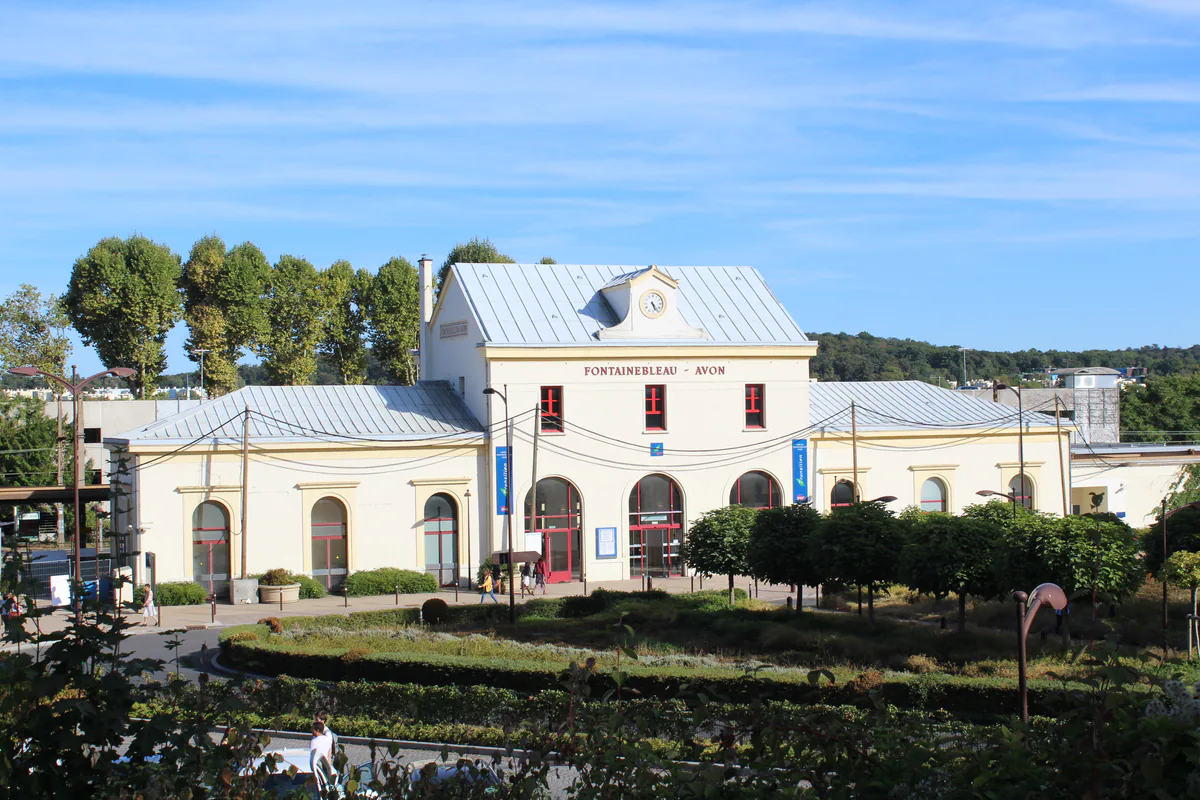
Fontainebleau-Avon is still the most flexible gateway for the town, château and several routes. It is not, however, “in the middle of the forest”. Depending on the day, a bus, bicycle or urban walk comes before your first trail.
Montigny-sur-Loing or Moret-Veneux-les-Sablons may suit a day in the Loing valley or eastern forest better. Look at the complete journey rather than choosing the best-known name. Our Walks from railway stations guide gathers published routes with roadbooks or GPX files and explains the difference between a loop and a one-way crossing.
The final leg to Barbizon, Arbonne and the Trois Pignons is often more complicated. A connection may exist without running at the time or frequency you need. Check both the outward and return journeys for the exact date.
Fontainebleau Forêt is not a return station
The Fontainebleau Forêt stop is appealing because you step off the train beneath the trees. It works in a very particular way, however. For the 2026 service, Transilien lists only two morning trains on Saturdays, Sundays and public holidays, travelling from Paris towards Montargis. Trains do not call there in the Paris-bound direction.
Engineering work can remove the stop on individual weekends. Check that “Fontainebleau Forêt” appears in the journey planner for your actual train, then choose a regular station for the return. The Transilien page about the forest stop also explains why passengers must alight from a particular part of the train. Follow the announcements on board.
Train and walking
Choose a loop that begins somewhere you can reach on foot, or an official crossing between two stations. Fontainebleau Tourism lists routes accessible from four Pays de Fontainebleau stations: Bois-le-Roi, Bourron-Marlotte-Grez, Fontainebleau-Avon and Thomery, together with a few neighbouring stations.
A route described as “station to station” is a full hike, not a short transfer. The official Fontainebleau-Avon to Bourron-Marlotte-Grez crossing, for example, is graded difficult and crosses plains, sandstone formations and wetland. For a first outing, the Thomery, Seine, walls and forest loop returns to the same station, provided you prepare the link to the route.
Download the map and roadbook before arriving. On leaving the platform, find the correct street or forest road before following the blue dot. Do not rely on a forest shortcut to reach the train. Sand slows your pace, darkness falls earlier beneath the trees than in open ground and mobile reception can be patchy.
Also check the ONF map of accessible areas. A traditional loop may now meet a closure following the fires of July 2026.
Buses and demand-responsive transport
Buses are useful between Fontainebleau-Avon, Avon, central Fontainebleau and some surrounding communes, but they do not stop at every forest trailhead. Search the full journey in the planner using the exact stop. A route that runs Monday to Friday may be sparse or absent on Sunday, and the last return matters more than the convenient outward trip.
The Gâtinais also has a demand-responsive transport service that must be booked. It is not an on-demand tourist shuttle and does not promise access to every car park. Check that your commune, stop, day and time are covered, then book through the official service. For Barbizon or the Trois Pignons, compare this option with a suitable walk, bicycle or taxi arranged in advance.
Train and bicycle
A bicycle opens up more possibilities, but it does not solve every connection. Under the current Transilien rules, a non-folding bicycle is accepted on weekdays before 6.30am, between 9.30am and 4.30pm and after 7.30pm, as well as at weekends and on public holidays. Space must always be available. TER trains using the same corridor may have different conditions.
Once in the forest, do not assume every forest road is an open cycle path. Confirm your route, respect closures and slow down around walkers. Deep sand and barriers make some links far slower than they appear on a road map.
Hiring a bicycle locally avoids carrying one from Paris, but confirm collection hours, return arrangements and the equipment provided. Ask for a lock, a basic repair kit and the right frame size.
Build a day with room for delays
For a town and heritage day, arrive at Fontainebleau-Avon, visit the château and keep any walk nearby rather than adding a long forest crossing afterwards. For a forest day, choose the route first and the station second. For a Seine and village day, Bois-le-Roi, Thomery or Moret may remove the need to travel via Fontainebleau.
Prepare a shorter option that ends where it began and a sheltered alternative for closures, wind or thunderstorms. Note where to find water and toilets before entering the forest. At the end, allow twenty to thirty minutes to find the right platform, buy a drink and absorb a small navigation error.
Staying overnight
A night near a station makes it easier to start early, return before the evening rush and enjoy the village after the walk. See Where to stay, then measure the actual walking distance between your accommodation, the station, a shop and your first trailhead. Central Fontainebleau is convenient for the château, but a base in Avon, Bois-le-Roi or the valley may make more sense for the walk that matters most.