
Barbizon and the forest edge
Exploring the forest near Barbizon
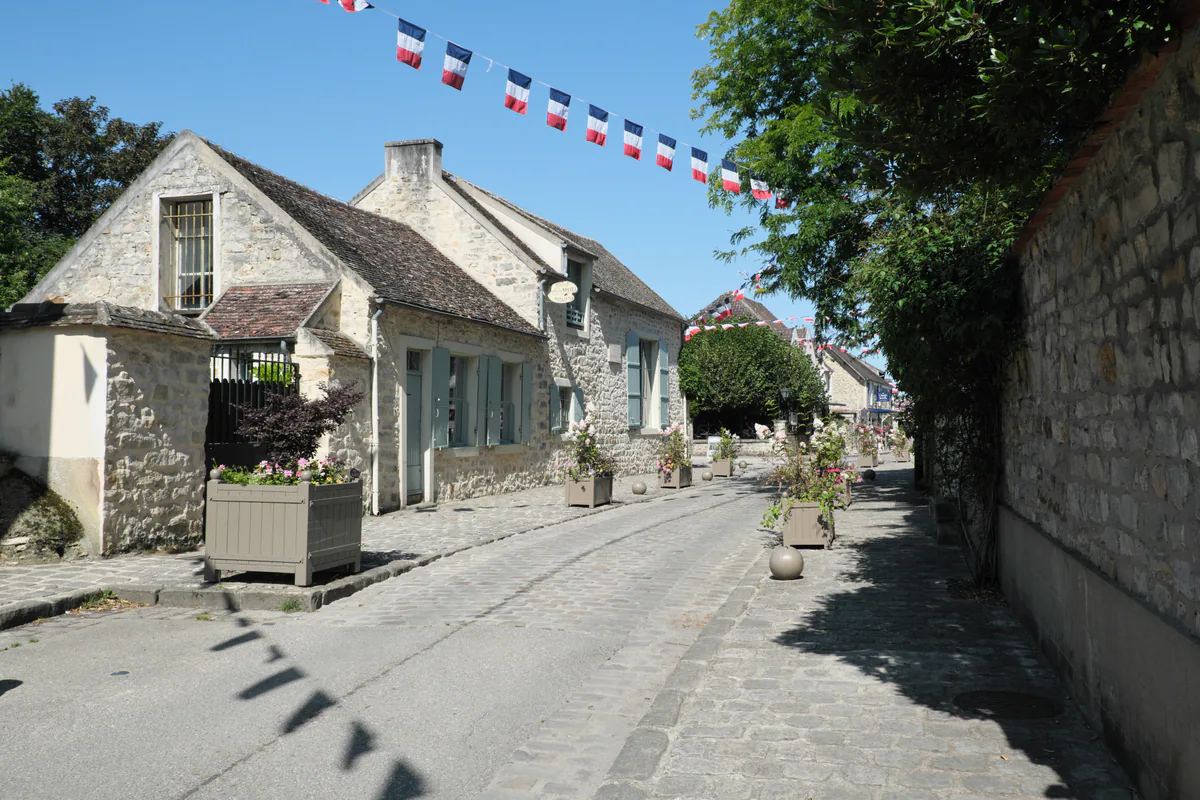
In Barbizon, village and forest belong together. The pleasure lies less in covering a long distance than in moving between paths, studios and the Grande Rue.
PLACES AND LANDMARKS
Find it on the map
Forest edge near Allée aux Vaches
BarbizonFrance
An orientation point at the forest edge. For the marked 6 km circuit, start at Place Marc Jacquet.
Place Marc Jacquet, start of the painters' trail
Place Marc JacquetBarbizon
France
Published start of the 6 km painters' circuit. Check the roadbook and access before visiting.
The forest at the end of the village
Barbizon is known for the painters who worked outdoors and made the forest their subject. Their story makes more sense on foot. Light breaks between the trunks, boulders interrupt the line of a path and the landscape suddenly opens at the forest edge.
Allée aux Vaches helps locate the forest edge near 48.442095, 2.618638. For a complete, waymarked walk, use the easiest starting point to recognise in the heart of the village: the official painters’ circuit begins at Place Marc Jacquet.
Begin with a short walk from an authorised access point. Check the current ONF map, since conditions changed after the July 2026 fires. A saved track or map point does not prove that a passage is open today.
The painters’ circuit is a strong first route
The Barbizon painters’ circuit is about 6 km, takes around 2 hours and follows yellow waymarks. The route page grades it easy and provides a downloadable guide. Eleven interpreted stops link village and forest, so you do not have to choose between local history and a walk.
The route introduces Auberge Ganne, Théodore Rousseau and Jean-François Millet before reaching the forest edge. Among the trees, the painters’ medallion, the Elephant boulder and several notable oaks provide concrete landmarks. Follow the current track rather than trying to reconstruct the order from this list. The continuity of the walk matters more than collecting all eleven signs.
The eleven stops, grouped into a story
In the village, Auberge Ganne begins the account. The former lodging house is now the departmental museum of Barbizon painters. The home and studio of Théodore Rousseau and the studio of Jean-François Millet then show that artists did more than pass through the village: they lived and worked here. Hôtel du Bas-Bréau completes this group of places connected with hospitality and conversation.
At the meeting point with the forest, one stop explains boundary marking, an easily missed detail that helps visitors understand property limits and the organisation of the massif. The Millet-Rousseau medallion honours the two figures most closely associated with the Barbizon School. The Elephant boulder then shows how the shapes of the sandstone fed the imagination of painters and later visitors.
Under the trees, the circuit refers to a painting by Jean-Baptiste Corot, Chêne Sully, Lantara’s sleeping place and Chêne Charlemagne. Together these stops connect a work of art, memories of artists and named trees. There is no need to memorise all eleven titles. Keep three themes in mind instead: where the painters stayed, how they entered the forest and what they chose to look at there.
The tourist office provides the complete roadbook. Use it for the order and detailed explanations, then put the phone away between stops. The circuit works best when the landscape has room between the interpretation panels.
Two hours is the walking estimate, not the length of the whole visit. With a pause, museum or lunch, allow half a day. Forest ground and time spent reading the interpretation naturally reduce your pace.
Several loops from the same village
The Barbizon visitor leaflet distinguishes a town loop, forest loop and Elephant loop. It also marks a mosaic trail. These are not four tasks to stack into a single day, but different ways to adjust the visit to your interests and available time.
- Less than two hours or uncertain weather: remain in the village around the Grande Rue, studios and mosaics.
- Half a day: choose the 6 km yellow circuit for the fullest balance between village and forest.
- Children mainly excited by the boulders: ask the visitor office about the current Elephant loop, then keep the distance appropriate for the group.
- A strong interest in painting: give Auberge Ganne or Millet’s studio proper time, then add part of a loop instead of rushing the museum.
Colours printed on a leaflet do not replace waymarks found outdoors. Ask for the current version at the visitor office at 84 bis Grande Rue and confirm which line corresponds to the route you have chosen.
Give the day room to breathe
Walk along the Grande Rue in the morning before it grows busy, and note the places you would like to visit. Then head into the forest with your map and a clear return time. Come back to the village for lunch or a museum afterwards. That rhythm keeps Barbizon from becoming little more than a car park for hikers.
Collections, studios and exhibitions do not all share the same opening days. Check Fontainebleau Tourisme and the venue’s own website before building your day around an indoor visit.
A comfortable day might begin on the trail at 9 or 10 in the morning, return to the Grande Rue for lunch and save one museum for the afternoon. If you prefer the lower light later in the day, reverse the order but calculate your return time in the forest. In autumn and winter, woodland grows dark noticeably earlier than the village street.
If rain changes the day
Light rain need not cancel the village. Begin with a museum or studios, then reassess the forest. If the sandstone remains wet, leave the boulders alone and choose the town section. This is not a timed ticket: shortening the walk can create more time for the places that genuinely caught your interest.
On a very hot day, reverse the plan. Walk through the wooded section early, return to the village before the middle of the day and save indoor visits for the afternoon. Carry water from the start even though shops look close on the map.
For a longer walk between Fontainebleau and Barbizon, Fontainebleau Tourisme also publishes a route marked “FB” between La Faisanderie and Barbizon, estimated at roughly three to four hours on foot. This is not an improvised extension of the yellow circuit. Prepare it as a separate outing and organise the return before setting off.
The “FB” route is especially interesting without a car because it links a point near Fontainebleau with Barbizon. It does not automatically return you to the start. Check bus 21 for the journey back towards Fontainebleau-Avon, or reverse the walk according to the timetable. A successful linear walk begins with the final bus, not the first waymark.
For a multi-day hike, the Tour du Massif de Fontainebleau covers 74 km in four stages through the landscapes and villages of the massif. Barbizon can then become an overnight stage rather than a separate excursion. This option needs itinerary planning, accommodation and a check of open sections; it is not simply a longer version of the painters’ loop.
Look at the landscape as the painters did
The artists who came to Barbizon did not discover an unchanging forest. They observed a living material: pale sand, boulders darkened by rain, leaves opening or closing a view, and woodland edges altered by work and human use. You can recover some of that attention without trying to reproduce a particular painting.
Choose three pauses. At the first, look only at colour. At the second, notice the shapes of trunks and rocks. At the third, turn around and study the path already walked. This gives the visit more texture than a rapid series of photographs. A sketchbook is pleasant, but a few minutes without a screen is enough.
Walk with your eyes open
Bring a small notebook or choose one detail to sketch. You do not need to know how to paint. Tracing the curve of a boulder makes you slow down and look. Stay on the path for photographs rather than trampling plants to find a better angle.
Damp sandstone is fragile. After rain, do not climb or rub the rock. The forest floor needs care too. Exposed roots, sandy soils and mosses all suffer when repeated shortcuts become a new path.
The Elephant boulder naturally attracts children and photographers. Stay on the existing approach, leave room for others and do not seek a better angle by climbing on damp ground. Treat the notable oaks similarly: enjoy their form and place in the landscape without crossing a boundary or compacting the soil over their roots.
Getting there and back
Barbizon has no direct train service. If you travel without a car, plan both the connection and the return before leaving. Use Île-de-France Mobilités alongside our Fontainebleau without a car guide.
Bus route 21 normally serves Barbizon from the Fontainebleau-Avon area, but times and stops can change. Search the exact journey for your date on Île-de-France Mobilités and look at the final return first. A taxi booked in advance can be a fallback; relying on a car being available at the last minute is less dependable.
The tourist office currently states that this bus runs from Monday to Sunday. That makes a car-free visit realistic, but not entirely spontaneous because the frequency is not comparable with an urban metro. Save the return stop and arrive a few minutes early, especially when finishing in the forest section of the circuit.
By car, do not assume that an empty verge is available for parking. Use a designated area and walk from there. If the car parks are full, enjoy the village and return for a forest walk another day.
Extend the stay without muddling the routes
Barbizon works well with an evening or overnight stay, particularly if you want an early start. See Where to stay once you know your route. For a more forest-focused second day, consider Arbonne or Franchard, but begin again with their own map and starting point.
The pleasure of Barbizon lies in moving between village and trees. Leave time for both; their proximity is exactly what gave the place its story.