
Boulders, sand and time to look
Family walks in Fontainebleau Forest
The best family walk is not necessarily the shortest. A visible goal, simple waymarks and an easy way to shorten the outing matter more than the distance.
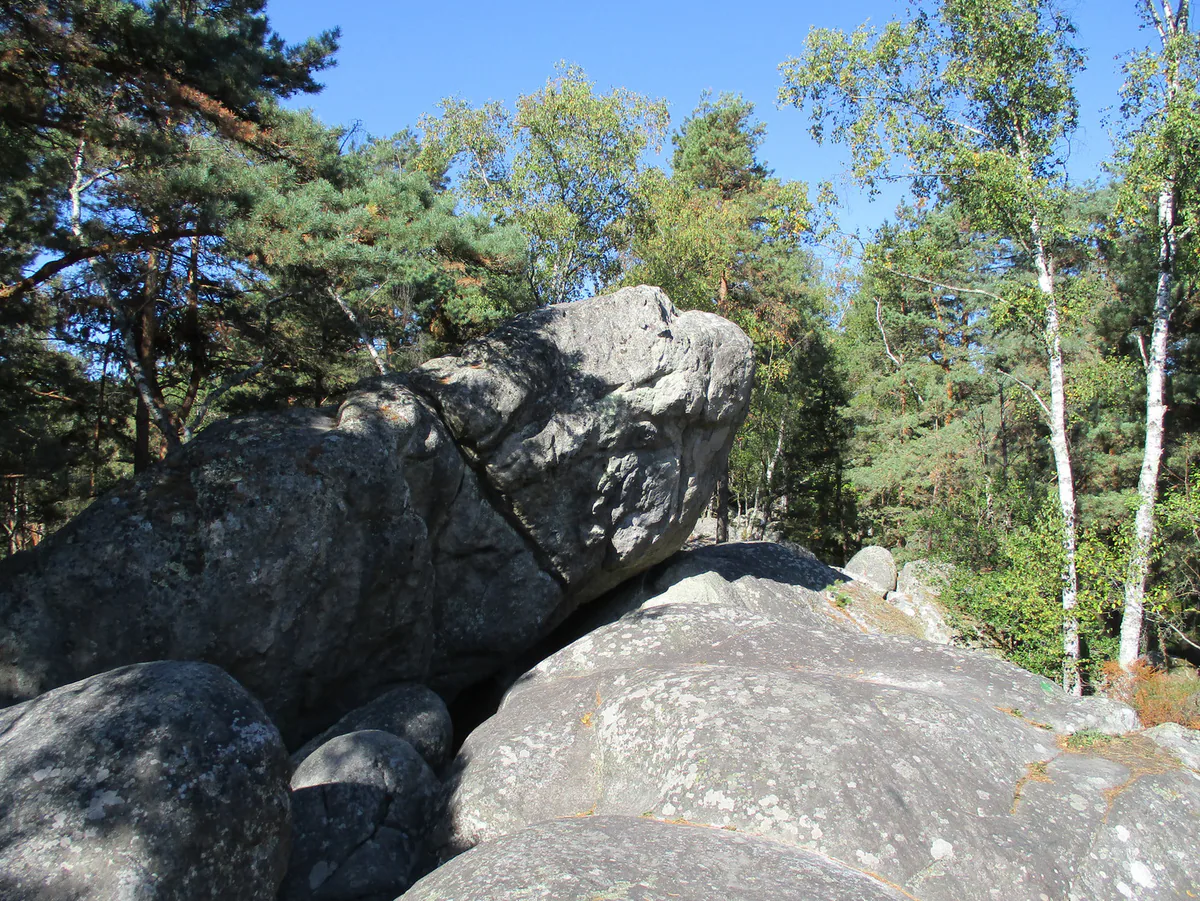
Forget the mileage record
In Fontainebleau, 2 km can happily fill a morning. Sand slows small legs, a passage between two boulders deserves three attempts and a pond can hold everyone’s attention for twenty minutes. None of that time is wasted. A family outing works when everyone can look, touch the bark, find the next landmark and turn back before tiredness makes the decision.
Begin with three questions: can the youngest child walk on uneven ground, do you need a pushchair or wheelchair, and where can you turn around without inventing a shortcut? Only then compare distances. Fontainebleau Tourisme’s family selection brings together walks and activities at different levels. Always open the individual route sheet rather than relying on the selection page alone.
Four outings with distinct characters
| Outing | What children are likely to remember | Who it suits |
|---|---|---|
| Cabaret Masson | A great oak, the Cyclops, a cave and six observation stops | Children already comfortable on sand, roots and small rocky passages |
| Mare aux Évées | Water, star-shaped ditches, bald cypresses and a former oil well | Families seeking an officially designated accessible trail, subject to current conditions |
| Franchard Arboretum | Many kinds of tree and a sensory visit | A gentler outing when the area is open and access has been confirmed |
| Perspective de Maintenon | A grand avenue, royal history and a view from Petit Mont Chauvet | Stronger young walkers comfortable with a route published as moderate |
These choices are not interchangeable. A rocky loop delights a child who loves clambering, but quickly defeats a pushchair. An improved path can reassure a multigenerational group, yet its condition may change after forestry work, fire or heavy rain.
Cabaret Masson, a small loop full of stories
Les Amis de la Forêt de Fontainebleau publish the Cabaret Masson walk as 2.6 km and about two hours including stops. Its route sheet was designed for groups of children and structures the walk around six observations: a notable tree, erosion, geology, blue-trail history, mosses and lichens, then dead wood and an open clearing.
Our Cabaret Masson guide gives the landmarks in order. Its great advantage for families is the rhythm: nobody has to walk for long before something appears. The loop still crosses sand and rocks. Closed shoes make more sense than a pushchair, and the coloured arrows of climbing circuits must not be mistaken for walking directions.
Give each child one simple job: find the next blue letter, notice the erosion-control steps or sketch the outline of the Cyclops. That keeps attention alive without turning the forest into a school worksheet.
Mare aux Évées and the Arboretum when access matters most
The Mare aux Évées trail is presented as accessible to people with reduced mobility. Its landscape is easy to read: star-shaped ditches converge on a central pond, bald cypresses suit the wet ground, and a surviving structure recalls twentieth-century oil exploration in this part of the forest.
The Franchard Arboretum is also published as an accessible trail. It was created from 1973 after a fire and brings many tree species together inside a fenced area. A guiding rail and improved sandstone sections help with orientation, while listening, looking, touch and smell provide a natural thread for the visit.
An accessibility designation is valuable, but check the current route page, parking, barriers and surface before leaving. The AFF trail-status page and ONF map may report a closure not yet reflected in an older leaflet. Narrow wheels, heavy rain or a fallen branch can change the real experience too.
Perspective de Maintenon for a little more walking
The Perspective de Maintenon trail is a published 4 km loop taking about 1 hour 30 minutes and rated moderate. The old avenue linked the Maintenon gate with Petit Mont Chauvet and was used for ceremonial arrivals and royal hunts. The climb brings a view towards Fontainebleau and a landscape quite different from the boulder fields.
Choose it with children who can save some energy for the return. The perspective gives everyone a clear goal, but the summit is not a purpose-built play area. Our Maintenon guide helps you prepare for the main direction changes.
Choose the turning point before setting out
On a loop, the mathematical halfway point is not necessarily the easiest place to stop. Find the last junction in the roadbook that allows a simple return along the same path. Tell everyone before starting: “At the cave, we decide whether to continue” works far better than negotiating after the group is already tired.
With young children, plan one strong objective. Seeing the Cyclops, watching the pond or reaching a viewpoint is enough. The château, a museum or lunch in a village can fill the rest of the day. Save long connections between separate forest areas for another visit.
Boulders are not an unlimited playground
On a walk, treat the boulders as part of the landscape rather than as an improvised climbing area. Do not let a child scramble above ground between rocks or enter a landing zone used by climbers. Numbered circuits are genuine sporting routes even when a white circuit is intended for younger climbers. A climbing session needs dry rock, landing pads, capable supervision and, for beginners, help from an experienced climber or professional.
Sandstone remains fragile and slippery after rain. Enjoy the shapes and passages between the blocks, then leave climbing for a dry day. Do not move dead wood or dig into sand below overhangs. These small spaces shelter quiet forms of life, and erosion begins surprisingly quickly.
A good morning begins the night before
Save the map and roadbook offline. Bring water, a snack, a light layer, a small first-aid kit and clothes that can meet the sand. Keep young children with a named adult, give them a phone number to carry and agree on the group’s meeting point before starting.
On the morning, open the ONF map of accessible areas. Following the July 2026 fires, several yellow paths remain closed or partly diverted. Barriers and signs on site always decide.
Finish before everyone is exhausted. Ten spare minutes to drink, shake sand from shoes and share the best moment will inspire another visit far more effectively than one compulsory final kilometre.